Showing posts with label writing. Show all posts

Monday, December 03, 2012

The pen and the desert


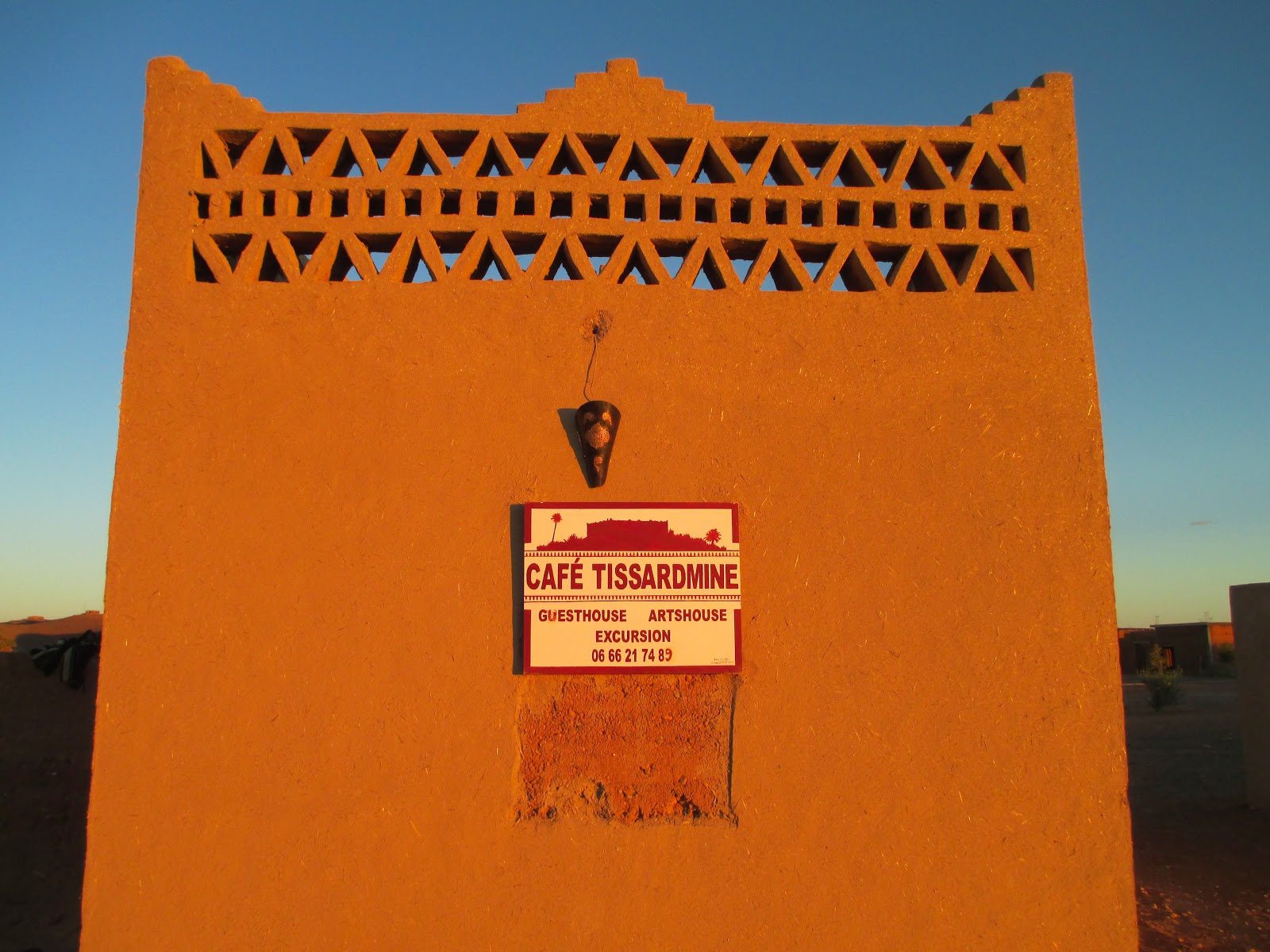
How far would you travel for a transformational writing workshop? There are many on offer in interesting locations -- Greek islands, the South of France, south-eastern Spain – that suggest a holiday atmosphere. So what about the Sahara Desert - a day’s camel-lope from a tarmac road? After my recent experience of leading a writing retreat in Morocco, I would encourage anyone to go a step or two further to 'Cafe Tissardmine' near(ish) Erfoud.

We know about the power of travel as a writing stimulant. Firstly there’s the effect of an unfamiliar setting, language, culture; a tonic to the senses. Suddenly we notice how much more we notice. Alastair Reid has written wonderfully about this in ‘Notes on Being a Foreigner’:

‘In a foreign country the pattern of days is less predictable – each one has its character and is easier to remember. So, too, the weather; and so, too, the shape and feel of newspapers, the sound of bells, the taste of beer and bread. It is all rather like waking up and not knowing who or where one is. If, instead of simple recognition, one can go through a proper realization, then quite ordinary things take on an edge; one keeps discovering oneself miraculously alive’.

Then there’s the effect of motion itself on our writing minds, whether it's walking, train travel, or the rhythm on the back of an animal. Tahir Shah, whose In Arabian Nights was one of my literary discoveries on this Moroccan adventure, captures this in describing his own response to the journey from his home in Casablanca to the South East of the country and the desert:

'Movement has a magical effect on the mind. It stimulates the eyes, distracts them, allowing real thought to take hold'.
To learn how to write on a camel, click here
I attribute my starting to write in 1995 to an early workshop experience combining an immersive experience with a place that contributed a significant personality. Lunga House near Ardfern, in Argyll, used to run a ‘creative space’ in the summer months and it was there that a small group of us hung on to Liz Lochead's every word for a week. It provided me with a combination of guided writing activities, encouragement towards independent writing and the freedom to roam over the local hills and coastal inlets in a kind of creative trance. It was a time out from ordinary life whose impact didn’t recede once it was over in the way that holidays often do. My second residential workshop was the gusty hilltop at Moniack Mhor near Inverness, a place I return to often now to teach. Interestingly participants in the residential Arvon Foundation courses frequently come some distance -- often from the south of England. I would say that the sense of displacement itself, of tipping out of everyday life, adds a significant element to their development as writers during their stay.

Although I've been in a desert before, and written here about its effect on me, Café Tissardmine Is perhaps one of the remotest inhabited places I have stayed. There’s 180 degrees of sky wrapping around you and a red plain for the eye to travel over. The effect of alienation together with some evocative journeys built into the design of the week are powerful experiences for writing.


Many of the workshop activities we did together were common to those I’d offer anywhere: close observation using all the senses, making abstract words concrete, playing with the power of dialogue. But the strange, red, wide place made other activities possible too. We each created a character, paying particular attention to what they wore on their feet and carried in their pockets. Then we walked them out of 'nowhere' towards the mud walls that enclose Café Tissardmine, passing fossilised fish locked into rocks, occasional date palms, a van stuck in soft sand. Sure enough each of the characters’ journeys became a story as they came to terms with the alien territory they moved through.

We also each chose a place nearby to revisit on several occasions during the week. This allowed the place to become familiar, but also allowed the effect of light and temperature to de-familiarise it. Under moonlight and stars a stretch of flat dune became a mountain; sunrise threw flat black shadows the opposite way to where they carved the land at sunset. We noticed the landscape’s tricksy character. It appeared so still and silent, but was a shape-shifter and it crept its way into our writing whether we wanted it to or not.


Karen Hadfield has created this quirky guesthouse/artshouse with a Berber business partner to provide just such experiences for people in need of creative or reflective time. Its other characteristics, not immediately to do with our individual writing experience, also shaped the week. There was no Internet, an intermittent phone signal, and limited power for light and heat for hot water. Our accommodation was in Berber tents woven for warmth from camel wool (although each had a double bed and flushing loo!). They were grouped around an intimate enclosure laid with rugs. Each breakfast-time and through each afternoon we shared the shade of the lovely ‘salon’ under canvas but open to the sky. The peace and stillness that characterised the place was frequently punctuated by our communal hoots of laughter. Each evening our applause exploded as the tagine lid was lifted and our sizzling aromatic meal revealed. There should be a word for the moment of teasing anticipation between the placing of the dish on the table and the lifting of the lid. A week of this home cooking was the most wonderful, and varied, treat.


The journeys we made together also played their part. We shared an eight-hour drive from Fes to Tissardmine. Rumbling the last miles by Land Rover at dusk in a sandstorm across the flat seemingly featureless plain, we were silenced by the place that would be our home for a week, in uneasy awe. Later we spent a day travelling with camels through the massive dune-scape, Erg Chebbi, and across a plain to a new camp for the night. The sunset, fireside drumming, Cassiopeia arcing over us during the long, bright night and then the transformational sunrise brought us into intimate contact with the sand, the stars, our hosts, each other. By the end of the week the landscape had shifted beneath us, made itself our home. We could pick out small landmarks and orientate ourselves by familiar shapes in the distant cliffs and mountains. We knew the ‘clock’ of sounds marking the transition from night to daybreak – the donkey near the well ‘going off’ like some sort or alarm, the raucous waking of the chickens, then the sheep silenced by Karen bringing their food, and finally her footfall on our rugs, bringing us morning tea just before sunrise.

By the time we travelled twelve hours together across the desert and over the High Atlas to Marrakech, we had learned the landscape together. How this will continue to resound in our psyches and in our writing remains to be seen. But my feeling is that it will linger long.


Monday, March 12, 2007

Creative Scotland Award!


I am thrilled to be a recipient of a Creative Scotland Award 2007. These Awards are supported by the National Lottery through the Scottish Arts Council and ten are given annually to individual artists who live and work in Scotland. They provide a unique opportunity to experiment and realise imaginative ideas in a major project.

My project will be a series of 'journey-essays' which link walking and writing. Walking is vital to my imagination and creative process – a meditation, a journey, a narrative, all closely connected. But as Rebecca Solnit says of the literature of walking, ‘the necessary combination of silver tongue and iron thighs seems to be a rare one’. Hopefully, I will prove to have both!

The focus is ten journeys driven by a fascination with landscapes that appear to be ‘wild’, but which are rich with human, but possibly hidden, meaning. Some will follow physical traces like a dry-stane dyke or a ‘well-worn’ route in a place where walking to get somewhere is the norm. Some will follow narratives. I will follow footsteps, such as my father’s ascent of Finsteraarhorn in Switzerland in 1952. I will trace memories, listen to whispers in the land and document my own responses. And I will experiment with how to craft narrative non-fiction so that it has the depth, intensity and resonance of my short fiction.

Through a series of workshops at festivals of walking and mountains, I hope to stimulate others to link creativity, writing and ‘wilderness’ experiences.

This is a unique opportunity for me to focus, experiment and create from a position of financial security. I start the project in July this year.

Wednesday, February 14, 2007

The Visiting Author


I wrote this story for the children at the International School of Tanganyika who I visited last week and who were full of curiosity, just as writers should be.

‘Why have you got such a big bag?’ a boy in the first class asked the visiting author.
She was a little surprised. She usually got questions like, ‘Where do your ideas come from?’ or ‘How many books have you written?’ Was her bag really so big, she wondered. She peered inside it to try and find the answer.
‘It’s because I have to carry so many characters around with me,’ she said. She counted on her fingers: ‘There’s the girl who’s fantastic at listening but is afraid of swimming, and would really like some more friends. There’s a boy who’s very good at shouting because he’s captain of the school Football Team, and a girl with bright red hair who likes to cause chaos. And that’s just in one story,’ she said. ‘There’s already an idea in there for another character.’
‘Who’s that?’ All the children were goggle-eyed.
‘It’s a large stripy cat with very sharp teeth but only half a tail. What do you think its name should be?’
While the children talked about the cat’s name, she picked up her bag and weighed it.
‘It’s heavy with characters,’ she said.
The class nodded and let her go now that they understood.

While the author was speaking to the second class sitting on their carpet, she saw out of the corner of her eye a little girl peer into the bag and then put her hand inside it. The girl suddenly snatched her hand back and sat with it under her arm as if she had been bitten. The author stopped speaking and looked at the girl.
‘What did you find?’ her classmates asked.
‘I saw some beautiful shells in there, lined with silver,’ said the girl. ‘And sitting in each one was a bright butterfly, each one with wings together like hands in prayer.’
The class gasped.
‘But when I put my hand in there, I felt some things squirming like slugs and they had horns like twisted branches and they smelt like mouldy old socks.’
‘Disgusting,’ the class said.
‘I think perhaps you came across my imagination,’ said the author. ‘You have to be brave to let your imagination go. It can bring things to life that you’d rather were asleep.’
The class looked at her. ‘But we are very brave,’ they said.
‘In that case,’ she said. ‘Close your eyes and ask yourself, “What if I found a big egg under a tree in the school garden…?”’
When they opened their eyes again, their imaginations had made eggs with spots and stripes and inlaid with gold. They had scrambled up trees and down drains and leapt between the stars to invent whole stories as different to each other as fishes in the Indian Ocean.
‘See how enormous your imagination is,’ said the author. ‘You need a very big bag to carry it around in.’

In the next class, the children couldn’t take their eyes off the basket, woven in red and purple. It seemed to have grown nearly as tall as the smallest pupil.
As they seemed unable to concentrate on what she was saying, she stopped and asked: ‘What are you all looking at?’
They giggled a bit, and a boy pointed at the bag and said, ‘Why’s it so big?’
‘Ah,’ she said. ‘That’s because I have to carry so many places around with me.’
‘Places?’ asked a boy.
‘She means settings for the stories,’ a girl corrected.
‘There’s a long white beach on an east African island in there,’ she said. ‘Hermit crabs scuttle across it, and if you listen hard, you might be able to hear a coconut falling from a tree.’
‘Where else?’ they asked.
‘There’s a snowy mountain-top in Ecuador at night-time; a tunnel under a Scottish mountain with rails running into the dark; a café by the sea in winter where you can eat special ice creams. It’s crammed with settings, you see.’ She held up the bag.
‘Will you need to get a bigger bag?’ someone asked as she left the room, struggling to lift it onto her shoulder.

At the end of the visit to the last class, she noticed the children were looking puzzled.
‘You brought a huge bag in with you,’ a girl said. ‘But you never took a single thing out of it.’
‘Ah,’ she said. ‘That’s because we didn’t have time to get to the end of the story. There’s plenty of endings waiting in there to jump out and attach themselves to our stories. They have strong pincers, just like crabs.’
‘Does it matter which one jumps out?’ asked a boy at the back.
‘Yes it does,’ she said. ‘Sometimes you have to pull one off so that you can try out another one and see how it fits.’
‘Ouch,’ the class said. ‘Why does it matter?’
‘Because we might disappoint our readers if we choose the wrong one, or if we don’t choose one at all, and say “then she woke up and it was all a dream”. If there’s something missing at the end, it will feel incomplete.’
‘Like a cat with half a tail?’
‘Exactly.’
The children were getting restless now, worried about getting this right.
‘But how do you choose?’ asked a girl at the front, straining with her hand up.
‘If you trust the story, it will know its own ending,’ the author said. ‘It feels right. In here.’ She pointed at her stomach.

When she stood up to leave the classroom, the children saw that she was struggling to lift the bag onto her shoulder. They were a little afraid to offer help in case they ended up inside the bag as characters for her stories.
But as they watched, a stripy cat skulked out from under a bookcase, lowered its stomach to the floor and put its back under the bottom of the bag. Its very short tail poked out at the back. The children heard tapping sounds, and realised that four crabs had scuttled from the edges of the room. Each one took up position under a corner of the bag, lifting it off the ground. The author stood tall, and she, the bag, the cat with half a tail and the four crabs all processed out of the room.